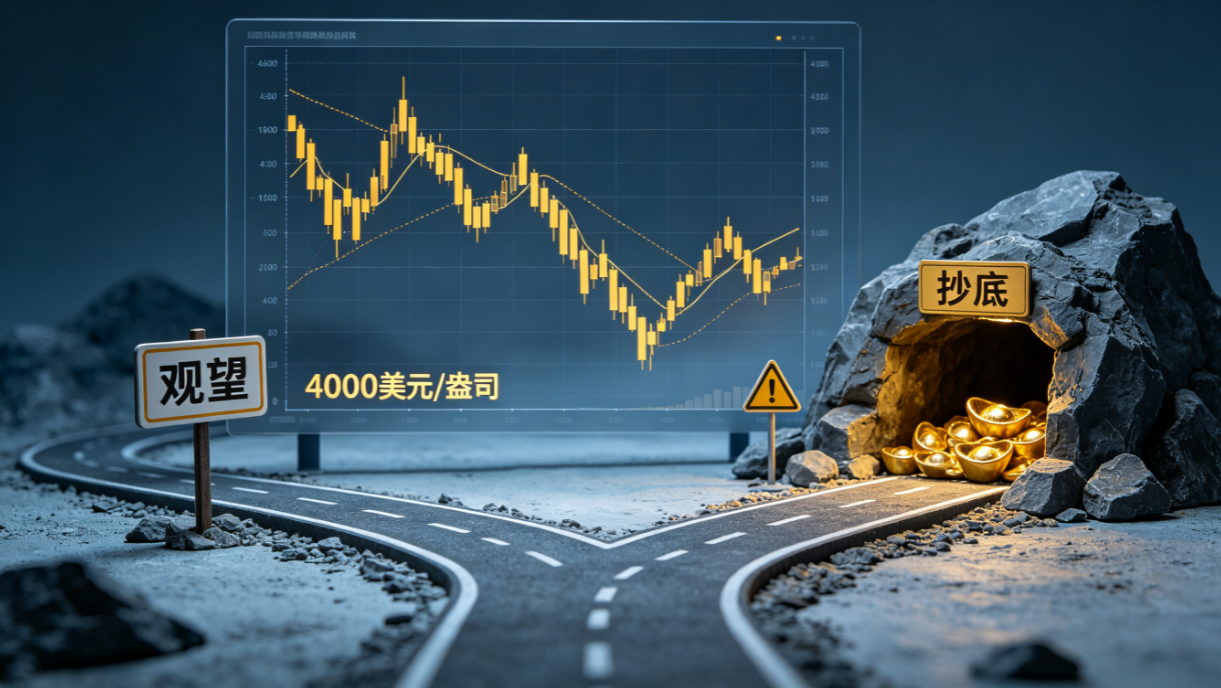
On June 24, market sentiment turned sharply, triggering a gold price correction that reversed the previous one-sided uptrend. London spot gold repeatedly fell, breaking below the key support level of $4,000/oz; domestic Shanghai gold weakened in tandem, losing the 900 yuan/gram integer mark.
Looking back to early this year, the gold market was unprecedentedly hot. International gold prices frequently hit new highs, domestic investment fervor was high, investors increased holdings of gold ETFs and bought bullion, offline gold stores saw buying frenzies, and major institutions remained bullish, with the long sentiment reaching a peak.
In just a few months, the market completely reversed. The weakening trend triggered large-scale fund outflows. Gold ETFs, which attracted significant inflows in Q1, faced massive redemptions in Q2, with large outflows from top products. At the same time, market sentiment shifted, with many investors who entered at high prices trapped, and those intending to buy the dip becoming cautious, overall holding cash.
International investment banks slash gold price targets
From the chart pattern, the recent decline in international gold is evident, with London spot gold moving lower and lower. As of press time on June 24 by China National Radio financial reporters, the pullback was significant, with London spot gold falling below the important psychological level of $4,000/oz. The domestic gold market also weakened, with Shanghai gold losing the 900 yuan/gram mark, trading at over 870 yuan/gram at press time.
Tan Haojun, an adjunct professor at Zhongnan University of Economics and Law, told CNR financial reporters that the gold price pullback is the result of multiple factors, the primary reason being the excessive rise and overheating earlier. Gold itself has core properties of preservation and safe-haven hedging, but prices have no basis for unlimited rises. Previously, international gold surged to above $5,500, indicating a significant valuation bubble.
Notably, in the face of the weakening gold price, Wall Street investment banks that had been collectively bullish sharply lowered their annual gold price targets. For example, Bank of America in its latest market report adjusted its previous gold price forecast, stating that the earlier target of $6,000/oz is essentially impossible to achieve.
Deutsche Bank, once firmly bullish, also changed its tune, expecting gold prices to average around $4,300/oz in Q3 2026 and $4,800/oz in Q4, significantly lower than previous forecasts. Additionally, Goldman Sachs and Citigroup have also lowered their short-term gold price forecasts.
Gold ETF fund flow reversal
The continued decline in international gold has also reversed the heat of domestic gold investment, with previously booming gold investments suddenly cooling. In Q2, domestic gold ETFs saw large-scale redemptions, completely reversing the inflow frenzy of early this year, with most products experiencing continuous net fund outflows.
Based on Wind data, CNR found that in Q1, the gold ETF market was hot, with major mainstream products seeing large fund inflows. Among them, Huaan Gold ETF and Guotai Gold ETF performed particularly well, with net inflows exceeding 10 billion yuan each. Meanwhile, Boshi Gold ETF, E Fund Gold ETF, ChinaAMC Gold ETF, and ICBC Gold ETF all had net inflows of over 2 billion yuan in Q1.
Since March, international gold prices began to decline, and gold ETFs saw a concentrated redemption wave starting in Q2. Huaan Gold ETF, the largest in the market, became the worst-hit area for fund outflows, with net outflows exceeding 9 billion yuan since Q2, ranking first among all gold ETFs. In addition, Guotai Gold ETF and E Fund Gold ETF both saw net outflows exceeding 2 billion yuan in the same period, with significant fund withdrawals from many mainstream products and a notable cooling of investment enthusiasm.
"When gold prices fall, it is normal for both A-share gold stocks and related ETF products to experience fluctuations, which is a typical market linkage. Many investors have a habit of chasing rises and selling on falls, buying when prices rise and panic selling when they fall. In this environment, the willingness of ordinary retail investors to participate in gold stocks has significantly decreased, and it is risky to rashly deploy related targets at this stage," Tan said.
How to operate after the heat subsides?
Recently, gold prices have repeatedly lost key levels, completely reversing the market investment atmosphere. Unlike the "crazy" gold buying earlier this year, most investors are no longer blindly following trends; waiting and struggling have become the mainstream mindset, and gold investment has completely returned from "frantic chasing" to calm observation.
Reporters noted that as gold prices continue to correct, the mentality of some investors has clearly diverged: those holding low-cost positions are calm, while those who entered at high prices are suffering.
For example, investor Ms. Li told reporters that she slightly increased her gold ETF position when gold was just above 900 yuan and plans to add more batches if prices continue to fall. She has been investing for several years and, due to low cost basis, even if prices continue to weaken, it's only a matter of how much profit she makes, with little overall pressure. Therefore, she does not advise friends without low-cost positions to blindly enter to buy the dip, to avoid being trapped at high levels.
Compared to low-cost investors, those who chased after missing the rally find themselves more passive.
Ms. Hu, who had been watching the gold market, hesitated to buy when gold surged past 1,000 yuan due to high prices. When gold fell to around 930 yuan, she decisively bought accumulation gold. Intending long-term investment, she did not take small profits when gold rose again, but then gold continued to fall, now below 900 yuan, trapping her position. Additionally, she also invested in gold stocks, and the dual losses made her helplessly admit, "I'm already numb, I dare not open my account to see the loss amount."
Tan Haojun believes that even if gold prices have room to correct, gold remains an indispensable core asset class in asset allocation. Compared to most financial products, gold's safe-haven properties are more prominent, and in the long run, it remains an important hedging asset for investors. However, entry timing is crucial; if bought at an unreasonable price, one will face loss risks from price fluctuations. Overall, gold is more suitable for medium- to long-term allocation, not short-term frequent trading.